NEWSLETTER 482: SATURDAY 8 APRIL 2006

Contents

1. Feedback, notes and comments

1. Feedback, notes and comments

Pursed-lipped The principal comment about last week’s piece was that the term was old enough to predate purses with metal lips and clasps. Others pointed out that one sense of the verb to purse given in the Oxford English Dictionary (a sense that’s older than the examples of purse lip) is “[t]o contract, to draw together (the lips, brow, etc.) in wrinkles or puckers, suggesting the tightly drawn-in mouth of a purse”, which also suggests a purse with a drawstring to close it.

Several subscribers argued that the presence of the verb to purse made pursed lips obvious, which explained why dictionaries didn’t include it. Some do give helpful definitions: the Oxford Dictionary of English says “(of the lips) to pucker or contract, typically to express disapproval or irritation”. But others explain the verb by the single word pucker, which doesn’t give the right idea at all—you might guess that purse-lipped meant positioning the lips to prepare for a kiss, quite the wrong idea. Even the OED’s definition fails to communicate the essential idea of disapproval.

Eugeroics Several subscribers learned in classical Greek came to my aid in finding the origin of this word featured last week. The most probable origin is the verb egeirein, to arouse or awaken (which, incidentally, I learned is the term in the Gospels that is usually translated as “resurrect” or “raise from the dead”). So eugeroic would be a partial and extremely irregular blend of eu- + (e)ge(i)r(-ein) + -(o)ic. Others pointed out that the word is confusing, since it seems to include the ger- stem from Greek geras, old age, that turns up in words like geriatric.

Kudos The April edition of MED Magazine, the monthly webzine of the Macmillan English Dictionaries resource site (which should be online very soon if it’s not already there), includes a short review of World Wide Words, which gives it 23 points out of a possible 25.

2. Turns of Phrase: Exercise bulimia

Bulimia is a well-known condition in which those affected have an obsessive desire to lose weight, which shows up as bouts of extreme overeating followed by fasting or self-induced vomiting or purging. Less well known is the variation exercise bulimia, in which the urge to lose weight leads individuals to engage in a frenzy of gym activity as a socially acceptable way to purge their bodies of unwanted nourishment and remove the guilt associated with eating. It’s often hard to diagnose, since it may not be obvious whether a person is just exercising a lot or is out of control. The term is over a decade old, but has been receiving more attention recently because Jamie-Lynn DiScala, who plays Meadow in the US television series The Sopranos, admitted in 2005 to having the disorder. A less common term for it is anorexia athletica.

Her exercise bulimia started when she was in her 30s and her son was in the hospital. She’d run up and down the stairs to his room. When he got out, she continued the compulsive exercise by running seven miles a day, followed by stomach push-ups, sit-ups, leg lifts and other calisthenics.

[St. Louis Post-Dispatch, 19 Mar 2006]

If you find yourself going to great lengths to hide how much you hit the gym, or you feel depressed when you miss a session, it may be a sign that you have exercise bulimia and should consult a mental-health professional.

[Town & Country, 1 Sep. 2005]

3. Weird Words: Abacot

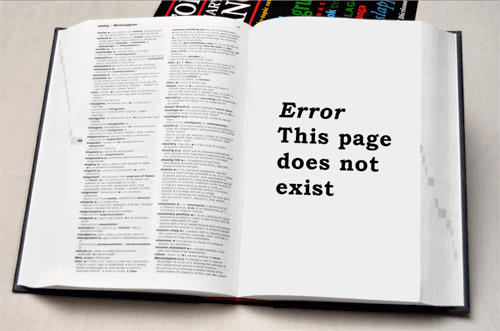
This word does not exist.

Generations of reference books once included this term, including the first edition of the Encyclopaedia Britannia, dated 1771: “the name of an ancient cap of state worn by the kings of England, the upper part whereof was in the form of a double crown”.

The trouble is, the word doesn’t exist. It was a misprint, which first appeared in Edward Hall’s Chronicle of 1548. It was copied by Raphael Holinshed in his own Chronicles of 1577 and hence by many others, including Nathan Bailey in his dictionary of 1721 and Noah Webster in 1828 (but not by Samuel Johnson in his dictionary of 1755, who was presumably saved from the blunder because the word was too rare and specialist to be included). A very few writers have used it in the reasonable belief that it was a real word, including George Augustus Sala, in his 1859 book Twice Round the Clock, or The Hours of the Day and Night in London, “The chandelier is of abnormous size, for any number of glittering festoons have been added to its crystal abacot.” (In case you’re wondering, abnormous is a real word, meaning irregular or misshapen.)

James Murray, the famous editor of the Oxford English Dictionary, found that the original word was bycoket, which was indeed a form of headgear, a cap or headdress with a peak both in front and behind, whose name derives from an Old French term for a small castle crowning a hill. He triumphantly proved his case in an article in the Athenaeum in February 1882: “There is not, never was, such a word”. In the OED’s entry for bycoket, he described the perpetuation of abacot as “a remarkable series of blunders and ignorant reproductions of error”.

One may argue that since the word appears in dictionaries, and has—albeit rarely—been used, then it exists and ought to be treated as a proper word. If it were more common, that argument would have great weight (there’s no shortage of words that have been altered out of recognition through popular error), but as it has almost never been used, we may allow Dr Murray’s view to prevail.

Notwithstanding that argument, the word remains an awful warning to the writers of reference works who may be tempted to copy material from earlier works without checking their sources.

4. Recently noted

Ideopolis Raise your glasses in a toast to London and Edinburgh, which this week have been designated ideopolises in the report of a study by the Work Foundation. An ideopolis is literally a city of ideas—a metropolis in which a large proportion of the workforce is engaged in what the report calls the knowledge industries, including healthcare, teaching, architecture, the media, artistic creation, research and development, and computing. The report has identified nine factors that drive the formation of an ideopolis, especially the presence of a university with good ties to its city that acts as a knowledge hub and stimulates growth. Other factors include diversified but specialised industries and good communications. The end-product is frequently manufactured goods, but of a sort—such as pharmaceuticals or semiconductors—that need the input of complex ideas based on research.

Blook One of the telltale signs to dictionary makers that a new word is becoming established is that compounds and derivatives are readily formed and used. That’s most certainly true of blog, the abbreviated form of weblog that has spawned terms like warblog, videoblog and litblog. Blook is the most recent form, a blend of blog and book. A blook is a blog that has been turned into a book. The word has been in the news because of the inaugural award in the genre, sponsored by a self-publishing Web site named Lulu, which named it the Blooker Prize (one for m’learned friends, you may feel). A total of 89 blooks were submitted for the Blooker by blauthors from more than a dozen countries. The winner was Julie Powell, who spent a year cooking all 524 recipes from Julia Child’s Mastering the Art of French Cooking. Among unsuccessful entrants was Belle De Jour: The Intimate Adventures of a London Call-Girl. The PR Newswire summed that up with the headline “Cooker Beats Hooker to win Blooker”.

5. Questions & Answers: Can of worms

[Q] From Kari Frisch: “I was wondering if you knew the origin of the idiom open a can of worms. I’ve heard that it might be associated with Pandora’s box.”

[A] To open a metaphorical can of worms is to begin to examine some complicated state of affairs, the investigation of which is likely to cause trouble or scandal and to give you much more than you bargained for. A recent example appeared in the Washington Times: “Uncovering past ownership, however, can open its own legal can of worms in exposing art theft.”

It has long since become an overused and overrated journalistic cliché, which rather lends itself to mixed metaphors: “Africa is a huge can of worms and we can no longer stick our heads in the sand” (from the Daily Record of Glasgow of 17 March 2006). The earliest example I’ve found is from a syndicated article in the Ironwood Daily Globe of Michigan in 1951: “The question of command for Middle East defense against Soviet aggression is still regarded as ‘a can of worms’ at General Eisenhower’s SHAPE headquarters here.”

We’re certain that the expression has nothing to do with Pandora’s Box. The evidence suggests that the original cans of worms were real cans with actual worms in them, collected as bait for fishing. Here’s one in a largely forgotten work of 1914, Diane of the Green Van, by Leona Dalrymple: “There are times, alas, when even fish are perverse! Thoroughly out of patience, Diane presently unjointed her rod, emptied the can of worms upon the bank, and returned to camp.”

It’s easy to see how an angler—more probably a non-fishing friend or relative of an angler—who opened a can containing a wriggling mass of worms would see it as something that was best left closed and unexamined.

6. Sic!

• “The new ‘Moo’ brand on the supermarket dairy shelves should appeal to connoisseurs of the unusual,” Chris Church says. “It’s described as: ‘Tasty milk from British farmers’.”

A small blue sign on a fence post says 'Revegatation Area Please Keep Our'.

• This seems merely to be an extremely public and unfortunate spelling error for revegetation, seen by your editor at Mount Cook village in New Zealand. But there are enough examples to be found in official documents both in that country and in Australia to make me wonder if that is an accepted spelling.

World Wide Words is copyright © Michael Quinion, 1996–2006. All rights reserved. This formatted version of the newsletter is intended for the private use of subscribers. Please do not reproduce it in this format in whole or part on any Web site or post a link to this page without the prior permission of the author. Your comments, feedback and corrections are always welcome.   Page created Saturday 8 April 2006.
