


Dydler
Pronounced /dɪdlə/
In 2007, the Royal Society for the Protection of Birds (RSPB) bought a remote fen in the Norfolk Broads, so isolated that few people had ever been there. This is from one report of the sale:
A few wild-fowlers would have visited it by boat when it was owned by Lord Percy; a handful of marsh men and sedge cutters still go there occasionally to harvest reeds; ditch “dydlers” are sometimes sent in to keep the water channels open from vegetation, and a few naturalists and artists know about this lost world of swamp and sky.
The Guardian, 8 Jan. 2007.
As this indicates, a dydler is a clearer of water channels in the Broads. He gets his name from his principal tool, the dydle. Though cutting drainage ditches has always been part of the job, the dydler used to be as often occupied with dredging navigable channels through the fens. This description of his work dates from a time when the job was relatively common and hints at the back-breaking work that must have been involved:
The dykes are kept clear, and the channel of the river deepened, by “dydling”, a dirty and laborious business. At the end of a long pole is a metal scoop, in the shape of a ring, with a network or coarse canvas bag, like a landing-net in shape, attached. This is plunged into the river, and scraped along the bottom to the side, where it is lifted out and the semi-liquid mud poured on to the rond.
Norfolk Broads and Rivers, George Davies, 1884. Rond is a Norfolk dialect word for the soft border of a waterway.
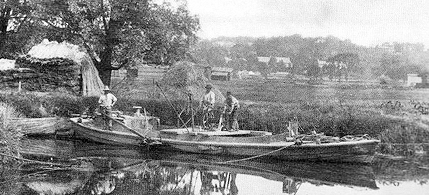
A dydler’s dredging barge from somewhere on the Norfolk Broads. (Photo by
courtesy of Robert Malster, author of The Mardler’s Companion)
The Oxford English Dictionary points out that early examples of dydle, from the sixteenth century, could also refer to a sharp triangular spade for edging ditches that was used in conjunction with a crome, a hooked stick to remove weeds. The OED spells the word as didler, because that's the form of the first recorded examples. It also says that the first vowel is that in died and guesses that it’s a cut-down version of dike-delve, but nobody really knows; it might be from Dutch, the language of the engineers who drained the fens.