


Ice house
Pronounced /ˈaɪs ˌhaʊs/
It is said that the Chinese invented the ice house as a building to preserve winter ice for use in summer, they having learned as early as the eighth century BC to store ice in caves or pits, using the evaporation from some of it to keep the rest cool.
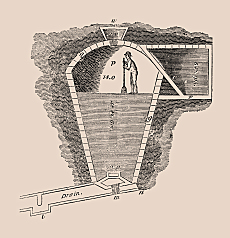
A section through an ice house
In Britain, the first recorded ice house was built at Greenwich in 1619, though there are earlier ones in southern Europe. The heyday of building them came in the eighteenth century, when no aristocratic estate was without one.
Ice houses were built underground, as a brick-lined pit 25 to 30 feet deep, usually in the shape of a blunt cone with the point downwards. The pit was covered by a more-or-less ornate domed roof with a north-facing entrance passage. Blocks of ice were cut from ponds or rivers on the estate and transported to the ice house, where they were stacked between layers of straw. Ice so preserved could keep for up to three years.
In the US, ice houses were once common, though there they tended to be surface constructions; as Richard Allen said decisively in The American Farm Book of 1858: “It is not necessary to dig into the earth for the purpose of securing a good ice house”.