


Quillon
Pronounced /ˈkwɪlən/
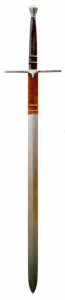
Early in the history of sword-fighting it was realised that a guard between the blade and the hilt was essential to stop the blade of your opponent from sliding down yours and cutting into your hand. The quillons are the cross-pieces at right angles to the blade and hilt that serve this purpose.
Though swords have had them for many centuries, this word for them isn’t recorded in English until R F Burton’s The Book of the Sword in 1884: “The quillons may be either straight — that is disposed at right angles — or curved.” (Before then, they seem simply to have been called cross-guards or just guards, as they often still are.) The origin is said to be the French quille, a ninepin, though that makes more sense when you learn the French also used it as a colloquial term for a leg, and so figuratively for the two legs represented by the jutting quillons. You may prefer to write the word as quillion instead, though this is less common.
In modern times, such technical terms have become useful in giving a sense of place and time in sword-and-sorcery fantasy tales, as here in a 1970 story by Fritz Leiber that was republished in 1995 in Ill Met in Lankhmar: “He took a few shuffling steps, tapping the cobbles ahead with wrapped sword, gripping it by the quillons, or cross guard, so that the grip and pommel were up his sleeve — and groping ahead with his other hand.” The other spelling appeared in Oathbreakers by Mercedes Lackey (1989): “The sheath looked as if it had once had metal fittings; there were gaping sockets in the pommel and at the ends of the quillions of the sword that had undoubtedly once held gemstones.”
The Oxford English Dictionary used to suggest it be said as a French word, /kijɔ̃/ , roughly “kee-yon”, but with the final vowel nasalised as in French bon. However, the current edition confirms that most people Anglicise it to /ˈkwɪlən/ (“quill-on”).
[The image above is of the type of two-handed broadsword used in the film Braveheart. It is reproduced by courtesy of Fulvio Del Tin of Del Tin Armi Antiche, Italy.]